
Joe had never really had to look for a job in his adult life. He started at a Fortune 50 technology company in 1994, left to serve in the military — six years active duty, Special Forces, combat medic, deployed to Kosovo and elsewhere — and then came back to the company. He stayed there for the rest of his career. Twenty-five-plus years total, managing a team that covered state and local government accounts across Texas. He promoted more than 40 people. He overachieved consistently. He understood hiring from the inside because he’d done it himself for more than a decade.
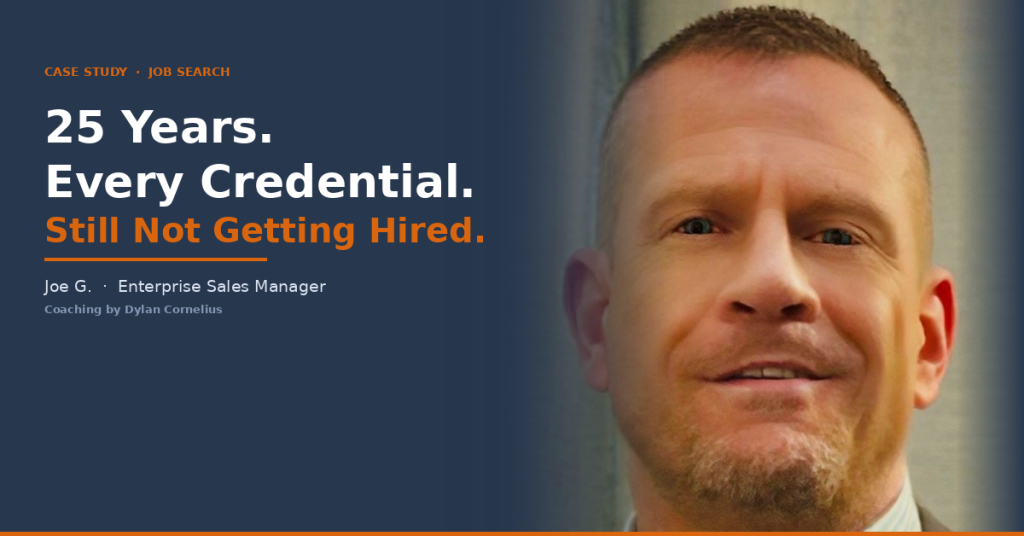
Joe G., Enterprise Sales Manager — Hired after 25 years at a Fortune 50 employer, a layoff, and a coaching engagement that changed how he saw every screening call.
Then in late August 2025, his employer restructured. Joe was out. He did what any reasonable professional does: took a few weeks to decompress, hired a resume writer, started applying. And when nothing moved the way he expected it to, he started wondering what the actual problem was.
That wondering was the beginning of something important.
What a Career That Never Required Job Hunting Leaves Behind
Joe had spent more than a decade interviewing other people. He’d screened candidates. He’d made hiring decisions. He knew what he was looking for. And when he walked into a screening call on the other side of the table, he carried that confidence with him — completely intact.
The confidence wasn’t unfounded. He’d built a real career. He’d sold $150–$180 million in technology to school districts, municipalities, and healthcare organizations across Texas. He’d managed 19 to 20 people at a time. His team overachieved in a year when most didn’t. His military background had given him structure, discipline, and routines that most professionals never develop.
He once described what that structure felt like: “The greatest thing the military brought me is I knew what I was wearing every day. I didn’t have to make that decision.” That certainty extended to everything — including, eventually, the interview room. Where he expected the world to confirm what he already knew about his own value.
Mostly, it didn’t.
Before
What He Was Up Against
- After 25+ years at one Fortune 50 employer, had never seriously job-searched outside his own company — it was his only employer since leaving the military in the early 2000s
- Already paid a resume writer before enrolling — the resume wasn’t the problem, and the $200 spent didn’t produce results
- Was getting to interviews — but couldn’t advance past the screening round, and didn’t know specifically why
What the Interview Actually Is
Here’s the reframe that changed everything: the interview isn’t a credential review. It’s a sale.
Each person in the process — the external recruiter, the HR screener, the hiring manager, the senior director — has a specific concern. A specific thing they need to feel confident about before they refer you to the next person. And if you walk in carrying 25 years at a Fortune 50 company and a military background and expect that pedigree to do the work for you, you’re going to keep stalling at the same point in the process.
That’s exactly what was happening to Joe.
The coaching work wasn’t about fixing his qualifications. It was about helping him see each conversation from the other side — what was this particular person actually screening for? What were they afraid of? What would make them comfortable enough to say yes to referring him forward?
And then, after each call that didn’t go the way he’d hoped: the post-mortem. What had he said? What hadn’t he said? What was the specific gap between how he’d presented and what they’d needed in order to trust him?
Working Together
What Changed
- Interview post-mortems: After every screening call that stalled, broke down exactly what had been said, by whom, and what each interviewer was actually trying to assess — specific and structural, not vague
- Perspective-taking: Stopped thinking about what he’d done and started thinking about what the interviewer needed from him in order to feel safe referring him forward
- Outreach targeting: Tightened focus from broad applications to roles and organizations where his background would read as a strength rather than a question mark
Getting interviews but not advancing? The issue is almost never your qualifications.
Schedule a Free Strategy Call →The Shift That Made the Difference
Joe had said something early on that stayed true throughout: “I don’t have time for complacency. I need substance. I want to do it right the first time.” That orientation — toward precision, toward efficiency, toward doing things correctly — was exactly what made the coaching work. He was coachable. He was willing to sit with the discomfort of being wrong about something he’d been certain about.
By December 2025, he was getting to final rounds consistently. He’d been one of the final two candidates at a company he wanted. He was in simultaneous processes at multiple organizations. And at the end of one of their last Zoom sessions, he said something that captured the shift:
“If I didn’t have the capacity to listen and to comprehend and to understand — ‘damn it, that might be true’ — I wouldn’t get another job. I think what I am is someone who can be a sponge. Sometimes you take a step back to take two steps forward.”— Joe G., Enterprise Sales Manager
He also said this, near the end: “My level of high and mighty, for lack of a better term, has been knocked down a couple — which isn’t a bad thing.”
That’s not a failure. That’s exactly what growth sounds like when it’s real.
After
Where He Landed
- Started advancing consistently through every round of the process — no longer stalling at the screening call
- Got to the final two at multiple companies simultaneously
- Received and accepted an offer — back to work within five months of the layoff
- Transformation: From “I know what I’m doing” to “I know what they need from me” — a different skill, and an entirely different result
Is This Where You Are?
If you’ve built a strong career — at a large company, in the military, in a role where your results spoke for themselves — the job market will feel like a foreign country. Not because your experience isn’t valuable. It is. But because selling yourself to people who don’t know your world is a different skill than the one that built your career. It doesn’t come automatically from 25 years of excellent work.
Joe figured that out. It took willingness to sit with being wrong about what was holding him back. And a partner invested in finding the right answer, not any particular one.
If you’re qualified and something keeps stalling — a free Strategy Call is where we figure out what’s actually happening and what to do about it.
Ready to stop stalling at the same point in the process?
Schedule Your Free Strategy Call →

